
Daylight saving time 2026: Here’s a fully rephrased, publication-ready version with an FAQ section added. I’ve kept the key facts and dates while making the wording original and easier to read.
Despite renewed efforts in Congress to make daylight saving time permanent, the proposal has not advanced through the Senate. As a result, most Americans are still expected to turn their clocks back by one hour in November 2026.
The annual “fall back” means people in most parts of the United States will effectively gain an extra hour overnight as daylight saving time comes to an end.
Here’s what to know about the 2026 time change, including when clocks go back, which states do not participate and where the debate over permanent daylight saving time currently stands.
When Does Daylight Saving Time End in 2026?
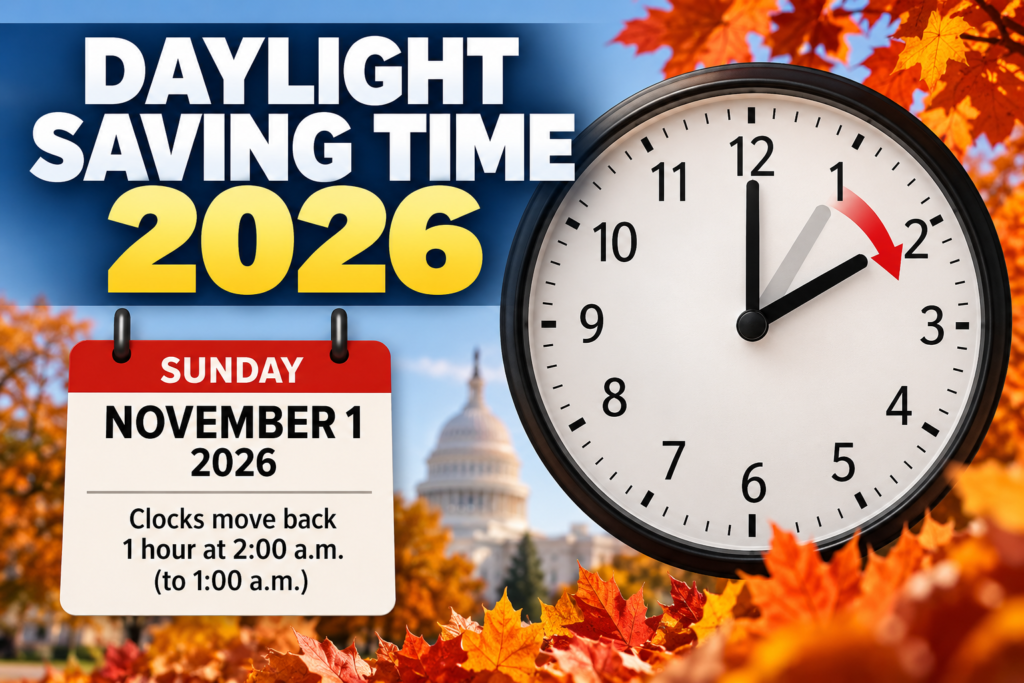
Daylight saving time is scheduled to end on Sunday, Nov. 1, 2026, at 2:00 a.m. local time.
At that point, clocks will move back one hour from 2:00 a.m. to 1:00 a.m., marking the return to local standard time.
For many people, this means an additional hour of sleep that night. It also means sunrise and sunset will generally occur about an hour earlier according to the clock.
Many smartphones, computers and other internet-connected devices adjust automatically. However, traditional clocks, watches and some household appliances may need to be changed manually.
Which States Do Not Observe Daylight Saving Time?
Daylight saving time is observed throughout most of the United States, but there are some notable exceptions.
Hawaii and most of Arizona remain on standard time throughout the year and therefore do not change their clocks in the spring or fall.
Several U.S. territories also do not observe daylight saving time, including:
- American Samoa
- Guam
- Northern Mariana Islands
- Puerto Rico
- U.S. Virgin Islands
There is an important exception within Arizona. The Navajo Nation observes daylight saving time, including the portions located in Arizona. This helps maintain consistent time across Navajo Nation lands extending into Arizona, New Mexico and Utah.
Why Does the U.S. Change Its Clocks?
Daylight saving time is regulated under federal law, which establishes when participating areas switch between daylight saving and standard time.
Under the current schedule, daylight saving time begins on the second Sunday in March and ends on the first Sunday in November.
The idea is to shift an hour of daylight toward the evening during the warmer months.
The United States has changed its daylight saving policies several times over the years. The issue became particularly prominent during the energy crisis of the 1970s, when the federal government experimented with extended daylight saving time as part of efforts to conserve energy.
However, concerns emerged about dark winter mornings, particularly for children traveling to school. Congress subsequently changed the policy and restored seasonal clock changes.
Could Daylight Saving Time Become Permanent?
The debate over ending the twice-a-year clock change has continued for decades.
More recently, lawmakers have considered legislation that would establish permanent daylight saving time and eliminate the need for most Americans to move their clocks forward and backward every year.
The Sunshine Protection Act of 2025, sponsored by Florida Rep. Vern Buchanan, gained significant support in the House of Representatives. The House approved the proposal by a 308-117 vote.
The legislation was then sent to the Senate for consideration. However, it has since stalled, meaning the existing daylight saving time schedule remains in effect unless Congress takes further action.
Why Do Some Lawmakers Support Permanent Daylight Saving Time?
Supporters argue that keeping daylight saving time throughout the year could provide several advantages.
One argument is that additional evening daylight could encourage people to spend more time outdoors and potentially support restaurants, retailers, tourism businesses and recreational activities.
Florida Rep. Gus Bilirakis has argued that more predictable daylight hours could particularly benefit states where tourism plays an important role in the economy.
Supporters also point to the convenience of eliminating the twice-yearly clock adjustment.
Why Do Some People Oppose Permanent Daylight Saving Time?
Critics say such a significant nationwide change deserves further study and debate.
One major concern involves darker winter mornings. Under permanent daylight saving time, sunrise would occur later during winter in many areas, potentially leaving commuters and schoolchildren traveling in darkness.
Opponents have therefore argued that lawmakers should carefully consider health, safety, education and regional differences before making permanent daylight saving time the national standard.
For now, the debate remains unresolved, and most Americans should expect to continue changing their clocks according to the existing federal schedule.
Frequently Asked Questions
When do clocks go back in 2026?
Clocks are scheduled to move back one hour on Sunday, Nov. 1, 2026. At 2:00 a.m. local daylight time, clocks return to 1:00 a.m. local standard time.
Do we gain or lose an hour when daylight saving time ends?
You gain one hour when daylight saving time ends in the fall. The clock moves backward from 2:00 a.m. to 1:00 a.m.
Which U.S. states don’t observe daylight saving time?
Hawaii and most of Arizona do not observe daylight saving time and remain on standard time throughout the year.
Does the Navajo Nation observe daylight saving time?
Yes. The Navajo Nation observes daylight saving time, including its territory within Arizona.
Do U.S. territories observe daylight saving time?
American Samoa, Guam, the Northern Mariana Islands, Puerto Rico and the U.S. Virgin Islands do not observe daylight saving time.
Will daylight saving time become permanent in 2026?
Under the current schedule, seasonal clock changes remain in place. Although legislation has been proposed to establish permanent daylight saving time, it has not completed the legislative process.
What is the Sunshine Protection Act?
The Sunshine Protection Act is legislation intended to end the twice-yearly clock change by establishing permanent daylight saving time in most areas that currently observe it.
Why do supporters want permanent daylight saving time?
Supporters say additional evening daylight could encourage outdoor activity, benefit businesses and tourism, and eliminate the inconvenience of changing clocks twice each year.
Why are some people against permanent daylight saving time?
Opponents are concerned about later winter sunrises and darker mornings. They argue that potential effects on health, school schedules, commuting and public safety should be carefully evaluated before making a permanent change.
Will phones automatically change the time?
Most modern smartphones, computers and internet-connected devices update automatically. Traditional clocks, watches, ovens, microwaves and some vehicle clocks may still need to be adjusted manually.
When will daylight saving time begin again?
Under the current federal schedule, daylight saving time begins on the second Sunday in March, when clocks move forward by one hour.
Clarify the bill’s current statusAdd a publication date disclaimer
Hi
Hi I am new here
Hi am new here
Hy
I love it
Very 😊